
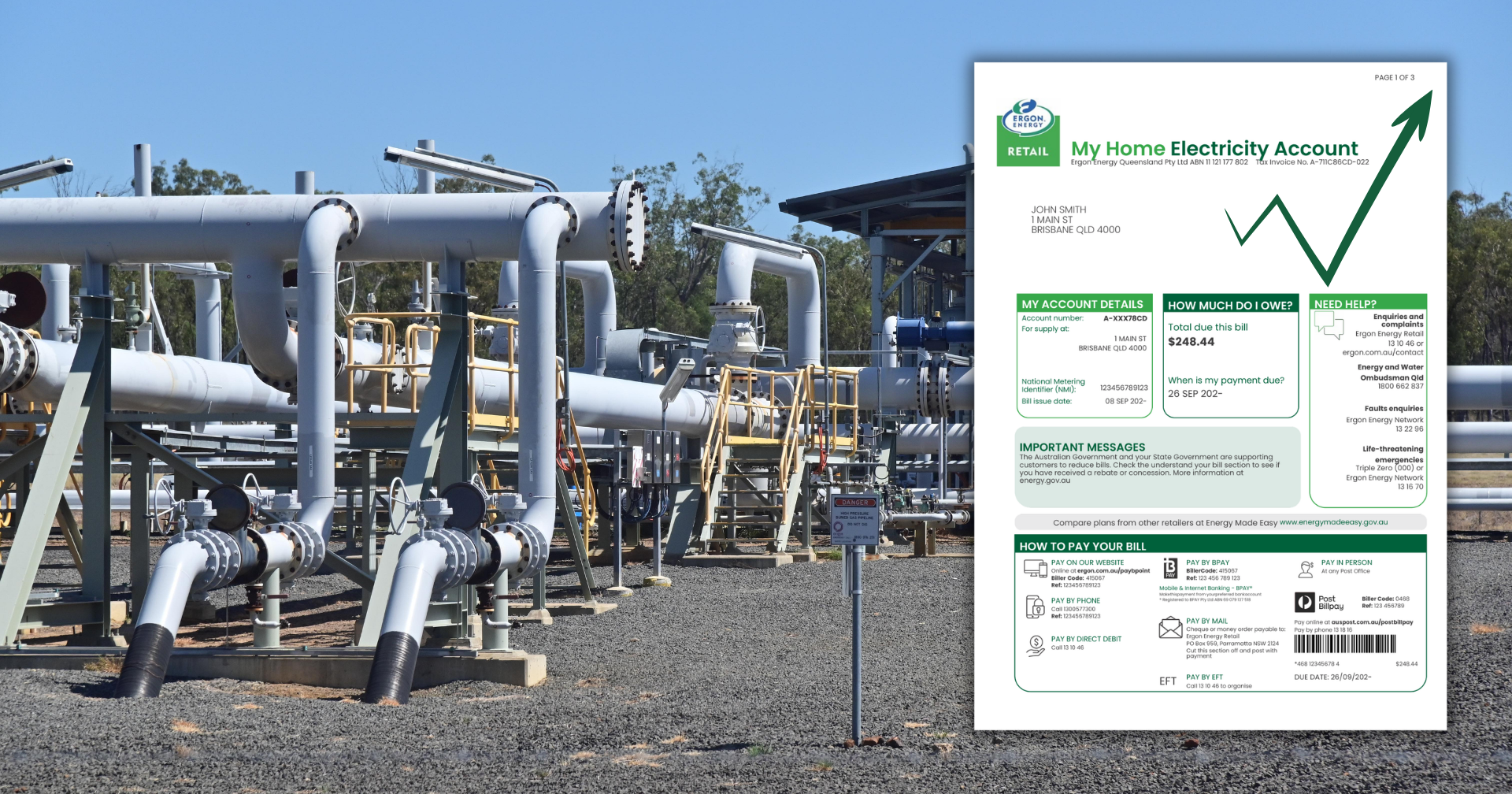
You’ve probably seen the news about the conflict in the Middle East, because it’s on every news channel, radio show, and newsfeed. What you might not have connected yet is that international conflicts like this one and the 2022 Ukraine war before it, have a habit of pushing up electricity prices as far away as Australia. Fuel shortages and price rises have an impact on more than just petrol at the bowser.
Here’s why global gas disruptions end up on your electricity bill, and what you can actually do about it.
Wait – I don’t use gas. Why does it affect my power bill?
Great question. Gas is only used to generate around 15-20% of Australia’s electricity, but it plays an outsized role in setting the price of electricity for everyone.
Think of it like this: the electricity grid runs a silent auction every five minutes. All the electricity generators, including coal, gas, solar, wind, put their electricity up for bid by your energy retailer. The cheapest sources get bought and used first. But here’s the catch: the most expensive generator needed to keep the lights on at any given moment sets the price for everyone, including the cheaper electricity sources.
Gas generators are typically among the most expensive. That’s why they’re only called on at peak periods, like hot summer evenings when everyone gets home and turns on the air conditioning. So when gas is expensive, it pushes up the price of electricity across the board, even for power that was generated by free sunshine or wind.
There’s another effect on top of that. Even when a coal plant is the one setting the price, coal generators often bid strategically in line with prevailing market prices, which are frequently influenced by gas. So a gas price rise can lift the whole market, not just gas generation.
The result? Research from Griffith University found that gas often influences a majority of electricity pricing periods in the national grid. Some analyses estimate up to 50-90% rise in certain conditions, despite generating only around 15-20% of Australia’s electricity.
So how much does a gas price rise actually add to your bill?
For every $1 rise in gas prices, the average household electricity bill goes up by roughly $20-50 per year – and in a serious spike, it can be $200 or more per year.
The technical version: each $1/GJ increase in wholesale gas causes wholesale electricity to rise by around $8 per megawatt hour (MWh). Since wholesale electricity makes up around a third of your bill, that works out to roughly $20/year for a typical home. It varies depending on your usage and where you are, but the direction is always the same: gas up, bill up.
That sounds manageable. But gas prices don’t move by $1; they move by $5, $10, or more during a real disruption. After Russia invaded Ukraine in 2022, east coast gas hit $24-27/GJ and average electricity spot prices more than doubled compared to the year before.
And gas isn’t the only pressure. Oil and diesel prices have surged alongside gas in the current crisis – and diesel is what powers the trucks, ships and machinery that keep the entire supply chain moving, including the coal and freight networks that feed the electricity grid. When diesel gets expensive, those costs eventually flow through too, just more slowly.
Doesn’t Australia have a gas price cap to protect us?
Yes – sort of. Here’s the simple version.
After gas prices went haywire at the start of the Ukraine War in 2022, the Federal Government introduced a $12/GJ gas price cap to stop gas producers charging whatever they liked for new supply contracts. It’s now part of something called the Gas Market Code of Conduct.
But there are two important limits to what it can do:
- The cap only applies to long-term supply contracts, not to the spot market. Think of it like a speed limit that applies to long-haul trucks but not to short local trips. A long-term contract is where a producer and a buyer agree upfront to a price for the next year or two; those deals can’t exceed $12/GJ. But the spot market, where gas is bought and sold day to day at whatever price the market sets, has no cap at all. Gas generators that need to buy gas at short notice go to the spot market and pay whatever it costs during that five minute auction. During a global disruption, that spot price can be well above $12/GJ, and nobody subsidises the difference. For example, during the Ukraine war in 2022, east coast spot gas prices spiked to around $40/GJ at times; more than three times what the cap is set at today. The generator just pays more, bids higher into the electricity market, and that’s how the cost reaches your bill.
- Even the capped portion still produces expensive electricity. Gas generators need to burn roughly 7 to 13 units of gas to produce one unit of electricity (depending on the type of plant). So even at $12/GJ – the capped price – a gas plant’s cost to generate electricity works out to $84 to $156/MWh before any profit margin. That is already higher than typical pre-crisis electricity prices.
The bottom line on the cap: It covers some of the gas market, some of the time. Long-term contracts are anchored at $12/GJ; that’s real protection. But the spot market (which is what generators fall back on when they need gas urgently) is completely uncapped and can go much higher during a crisis. And even when gas is at the capped price, it still produces electricity expensive enough to push your bill up. The cap stops a catastrophic spike; it doesn’t stop a significant one.
It’s also worth knowing that electricity pricing rules vary depending on where you are and which electricity retailer services your area, so the exact impact on your bill will differ from household to household.
What’s changing from 2027?
There’s some relief on the horizon. In May 2026, the Federal Government announced that from 1 July 2027, LNG exporters will be required to reserve 20% of their exports for the Australian domestic market. The idea is simple: more local gas supply should mean lower prices. It’s a meaningful policy shift, but it won’t help your bill before 2027 — and the spot market will remain uncapped even after that.
When does this actually show up on my bill?
Most Australian households and small businesses are on annual electricity contracts that reset on 1 July each year. The Australian Energy Regulator (AER) sets a reference price, called the Default Market Offer, every May, which takes effect July 1. Even if you’re on a market deal rather than a standing offer, most retailers reprice their plans around the same time.
This means a gas price spike happening right now may not show up on your bill immediately. But it will show up when your contract resets – because the regulator sets that new price using current market data.
Larger businesses are often more exposed than households. Many big commercial and industrial customers negotiate their own electricity supply contracts directly; shorter-term deals that get repriced more frequently than once a year. When wholesale prices spike, their contracts come up for renewal sooner, and they feel the increase much faster – sometimes within weeks.
So where does solar fit into all this?
The world was already moving towards renewables; not just for environmental reasons, but because solar and wind are now the cheapest forms of new electricity generation in Australia.
What global energy disruptions keep reminding us is that fossil fuel prices are unpredictable. They’re linked to geopolitics, shipping routes, international markets, and forces entirely outside our control.
Solar on your home gives control and independence, instead of a shock in the mail. A solar system installed on your roof generates electricity at zero fuel cost, no matter what happens to global gas prices, oil prices, or anything in between. The payback on that investment gets shorter every time electricity prices rise.
If you’ve been sitting on the fence about solar, it’s worth at least understanding the numbers for your specific situation.
Contact us or give us a call on 07 4642 0017 or to request a free quote and we’ll help you understand your current electricity needs and how solar can help you meet them.