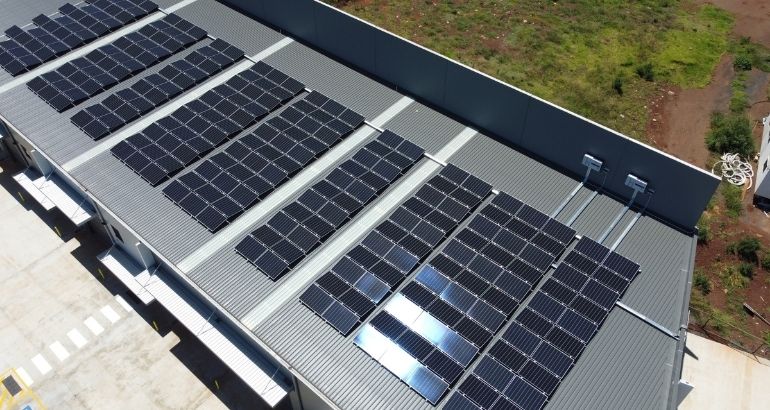
If you’ve ever received a quote for commercial solar, you’ll probably recognise the number 99 kilowatts. For the past fifteen years that’s where most quotes stopped, because that’s where the federal rebate stopped. Plenty of businesses with the roof space and the power bill for something twice that size got sold the smaller system anyway, as that’s simply where the incentive and savings ran out.
From 1 October, that ceiling lifts to 1 megawatt.
It’s the biggest change to commercial solar since the scheme started in 2011, and for farms and businesses across Southern Queensland it’s very good news. There’s also a detail in the announcement that most of the coverage has skipped, and it works in your favour, so here’s what you need to know.
What’s changing, and what it’s worth
The Small-scale Renewable Energy Scheme is the same scheme that already discounts residential solar and home batteries. From 1 October its cap lifts from 100 kilowatts to 1 megawatt, which the government estimates will take around 20 per cent off the installed cost of a commercial system.
Their own examples are a 250kW system getting about $68,000 off upfront while saving roughly $50,000 a year on power, and an 850kW system getting about $232,000 off while saving around $175,000 a year.
The part that gets missed
Normally the rebate shrinks every year. It pays you upfront for the power your system is expected to generate between installation and the day the scheme ends, which is 31 December 2030. So as 2030 gets closer there are fewer years left to pay for, and the discount steps down by one year every 1 January.
That still happens for systems under 100 kilowatts. It does not happen for the newly eligible systems.
For systems between 100 kilowatts and 1 megawatt, the Minister has frozen the rate at five years all the way through to the end of 2030, with the annual step-down removed.
| Year installed | Under 100kW | 100kW to 1MW |
|---|---|---|
| 2026 | 5 years | 5 years |
| 2027 | 4 years | 5 years |
| 2028 | 3 years | 5 years |
| 2029 | 2 years | 5 years |
| 2030 | 1 year | 5 years |
In practical terms, a business installing an 850kW system in 2029 gets the same discount as one installing this December. A 99kW system installed in 2029 gets less than half.
Already have solar? You can add to it
This is the detail worth knowing if you’re one of the many businesses sitting on a system that was limited by the 99kW cap.
What counts is the combined capacity after the expansion. A shed with 80kW that adds another 30kW becomes a system over 100kW, and the frozen five-year rate applies to it. An existing 100kW system can have up to 900kW added, as long as the total stays under a megawatt.
The catch is at the top end. If the finished system comes to more than 1MW, none of it is eligible, so a 2MW installation can’t claim on the first megawatt. It stays under the existing large-scale solar scheme instead.
The real constraint is getting connected
With the deadline pressure gone, the thing that actually determines when your system happens is grid connection approval.
A commercial system can’t just be switched on. Your network distributor has to approve the connection first, which means approval from Ergon across most of the Downs and Energex through the Lockyer Valley and Ipswich. For a house that’s usually simple. For a several hundred kilowatt system, it’s a proper engineering assessment, and it goes into a queue.
Before you receive approval, they will assess:
- What your system does to the voltage on that section of line
- Whether the local network can absorb what you’re exporting
- Whether anything needs upgrading before you connect
Much of the network throughout the Downs was built to deliver power out to properties, not to have several hundred kilowatts pushed back up the line.
Timeframes depend almost entirely on what they find:
- Existing compliant supply with capacity to spare: you might get approved in a matter of months
- Network needs upgrading first: considerably longer
The Smart Energy Council’s recent industry report found connection processes to be the single biggest barrier to commercial solar nationally, with 71 per cent of members citing slow distributor approval times and one practitioner reporting approvals that took five months instead of the expected five to ten business days.
The government has asked the Australian Energy Market Commission to look at requiring faster processing, which is welcome but may not happen overnight. Lodging a connection enquiry is the best place to start, but does come at a cost. The fee structure varies across entities and usually starts at around $1,200.
Don’t count yourself out over an imperfect site
Most of the coverage assumes a big modern shed with a clean roof and plenty of switchboard capacity. Plenty of businesses out here don’t have that, and it doesn’t rule you out.
Older sheds can usually carry solar, but they need an engineering assessment first. Occasionally the better answer is to extend or replace the shed, so you end up with the machinery space as well as the panels.
Especially in agricultural installations, not enough roof is common, and the usual fix is a split system, using the shed for what it’ll take and ground mount for the balance. We developed our own ground-mount system which works well on local soil.
Several buildings across a property often means more capacity available than it first appears.
It’s worth knowing that engineer reports and evidence of connection approval will be required for systems in this range, as they already are under the large-scale scheme. So the structural assessment isn’t optional paperwork; it’s part of qualifying.
Where to start
The order we’d suggest:
- Get twelve months of usage data from your retailer. It shows us the shape of your day’s consumption, rather than us guessing from a quarterly bill.
- Feasibility report or energy assessment. A quick software design to model your site’s energy consumption and show what renewables could achieve for you.
- Lodge the network connection enquiry. First, before you’ve chosen equipment or signed anything.
- Have the roof assessed for structural capacity and condition.
- Design the system, based on what the network will allow and what you actually use.
Done in that order you’ll know where you stand early. Done the other way around, you find out late.
One last thing worth saying: size the system to your usage, not to the cap. The commercial solar that works well is the solar that gets used on site while the sun is up, so irrigation, cold storage, packing lines, processing and workshops are covered. If most of your power gets used after dark, a bigger array isn’t necessarily the answer, but batteries might be, and that’s something we can discuss.
Ready to find out where you stand?
Proven Energy has been installing residential, commercial, agricultural and off-grid solar across Southern Queensland since 2012, with offices based in Toowoomba.
Give us a call on 07 4642 0017 or request a free quote. The connection enquiry costs nothing and it’s the part with the longest wait, so the earlier we start it, the better your options. Less hassle, more value!
Figures are estimates based on current certificate prices and will vary with your location, system design and market conditions. The expanded scheme is subject to final regulations.