
Now that the federal rebate is lifting from 100kW to 1MW, a lot of farms are looking at systems several times bigger than anything they’ve considered before. The first problem most of them run into is space.
A megawatt of panels takes up a fair amount of room, and not every property has a machinery shed big enough or a roof in good enough condition to carry it. That doesn’t rule you out, but it does mean the design conversation starts somewhere different.
The good news is that you have time to get it right. For systems between 100kW and 1MW, the incentive rate has been frozen at five years all the way through to the end of 2030, so there’s no annual step-down to race against. Working out the best layout for your property costs you nothing in rebate value.
Here’s what the options actually look like.
Start with the roof, even if it’s old
Shed roof space is almost always cheaper per kilowatt than a ground mount, because you’re not paying for frames, footings, trenching or fencing. So the first question is how much of your system the existing buildings can carry.
An older shed can often take solar perfectly well, but it needs a structural assessment before anything goes on it. What matters is the purlin spacing, the condition of the sheeting, the age of the fixings and whether the building was ever engineered for that kind of load. Wind loading is a significant consideration as well, particularly on exposed sites.
That assessment isn’t optional, either. Engineer reports will be required as part of qualifying for the rebate on systems in this range, the same way they are under the existing large-scale solar scheme.
Sometimes the assessment comes back and the numbers point somewhere else entirely. If the shed is at the end of its life anyway, replacing or extending it can make more sense than going to ground mount, because you end up with new machinery space as well as somewhere to put the panels. That’s a much bigger upfront cost and a longer payback, so it won’t suit everyone, but for an operation that was going to need more shed eventually it’s the better use of the money.
Splitting between roof and ground
Most farms that need a large system end up doing both. The shed carries what it can, and a ground mount makes up the difference.
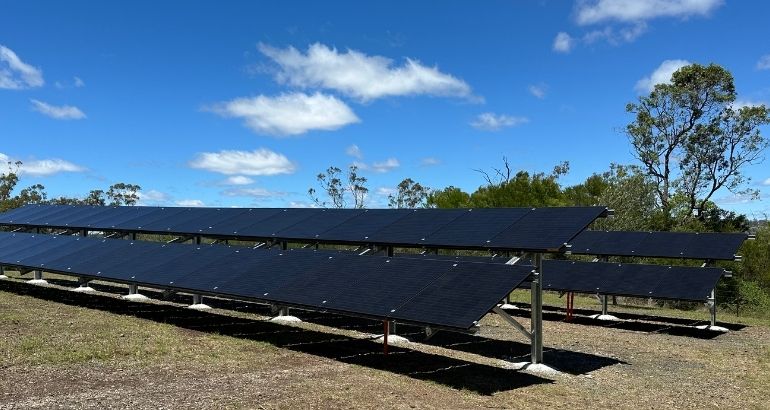
We developed our own ground-mount system so that we could account for varying soil types and ensure the array stays stable in the conditions it’s installed in. A custom design also lets a system use the roof and the ground together rather than forcing a choice, and it means the array can be laid out around the shape of your property instead of a standard product dictating the layout.
If you have several buildings across the property, there’s often more usable roof available than it first appears. We’ve designed systems across multiple meters to make the most of a property’s total capacity, which is something that becomes more useful at this scale rather than less.
It’s also worth knowing that if you already have solar, adding to it counts under the new scheme. What matters is the combined capacity once the expansion is finished. A shed with 80kW on it that adds another 30kW becomes a system over 100kW, which is where the frozen rate applies. The only limit is at the top: if the finished system comes to more than a megawatt, none of it qualifies.
Is the ground worth more under panels or under production?
This is the question we get asked most, and it’s a fair one. Nobody wants to take good land out of production for something they’re not sure about.
The honest answer surprises people. A megawatt of ground mount sits on roughly two hectares, and in our region that generates around 1,400 megawatt hours a year. If you’re using most of it on site, at current commercial rates that’s a few hundred thousand dollars a year you’re not paying your retailer. Even if you exported the lot at a poor feed-in rate, you’d still be looking at tens of thousands. Compare that to what two hectares returns under grazing, which is a few hundred dollars a hectare, or under dryland crop, and the difference isn’t marginal. It holds up against irrigated country too.
That doesn’t mean you should put panels on your best land. It means the land cost is rarely the thing that decides it, so if space is the sticking point, there are usually better places to look first:
- Fence lines and headlands, where you’re not losing much production anyway
- The edges of irrigation channels, which are already out of the cropping area
- Awkward corners and scrub that aren’t earning their keep
- Ground near the pumps, so you’re generating close to where the load is
- Dams, using floating solar, which has the added benefit of reducing evaporation
Running stock under panels
Grazing under a ground-mount array is possible, and plenty of operations do it. Sheep are the usual choice, because they keep the grass down and save you slashing, and they aren’t tall enough to interfere with the panels or the cabling.
Cattle are less suitable. They rub against the frames and cause damage, and they can reach cabling that sheep can’t. It’s possible to engineer around this by raising the array, but the additional wind loading requirements make that considerably more expensive, so fencing them out is generally the cheaper option. If the array runs along an existing fence line, adding a second fence on the other side gives you a laneway with the solar protected down the middle.
In either case, cabling needs to be installed so that stock cannot reach it. Mesh beneath the panels is one way of managing this.
Size it to what you use during the day
The farms that get the most out of a large system are the ones using power while the sun’s up. Irrigation pumping, cold storage, packing lines, dairies, feedlots, grain handling and workshops all fall into this category.
Every kilowatt hour you use on site is worth what you’d have paid for it, which is several times what you get for exporting the same power. So the value of a system depends far more on your usage pattern than on how many panels you can physically fit.
That’s why the most useful thing to pull together before getting quotes is twelve months of interval data from your retailer. A quarterly bill tells you what you spent, while interval data shows when you were actually using power, which matters a great deal on a farm running irrigation on a time-of-use tariff. You can usually access this information by logging into your energy retailer portal.
Don’t forget the connection
The other constraint that decides what you can build is the network. A large system needs approval from Ergon or Energex before it can connect, and on long rural feeders the answer sometimes comes back with a limit on how much you can export.
For an operation using most of its power on site during the day, an export limit often doesn’t hurt the numbers much. But it is something you need to know before the system is designed, not after, and the enquiry can take quite some time, so it’s important that it’s the first thing you start. Here’s what’s involved in getting connection approval.
Ready to work out what fits?
We’ve been designing agricultural solar across Southern Queensland since 2012, including ground mount, off-grid and systems spread across multiple buildings and meters.
Give us a call on 07 4642 0017 or request a free quote, and we’ll work out what your property can actually carry. Less hassle, more value!